6
Mar
Death Tarot Card Meaning: Clear Guide to Powerful Symbolism
Death Tarot Card Meaning: A Clear Powerful Guide

Death Tarot Card Meaning illustrated through the Major Arcana card symbolizing endings, transformation, and renewal
What the Card Actually Represents
The Death Tarot Card Meaning carries more nuance than most people expect when they first encounter it. As a subject within tarot, this card is one of the most misread in the entire deck. People unfamiliar with tarot tend to react to the name alone, which does the card a disservice. In practice, this card carries meaning rooted in transformation, endings, and the clearing away of what no longer serves a purpose.
It belongs to the Major Arcana, the twenty-two cards that form the symbolic backbone of a tarot deck, each representing a significant force or turning point in human experience. Death sits at position thirteen in that sequence, a number that carries its own long history of unease in Western culture, which is part of why the card has accumulated so much unwarranted dread before anyone even reads it.
Understanding the Death Tarot Card Meaning begins with setting aside literal interpretation. The card does not predict physical death. What it does signal is the kind of change that cannot be undone, a crossing of a threshold from one state of being into another. Readers who work with this card consistently note that it tends to appear when something in a situation has already run its course, whether that is a relationship, a phase of life, a belief system, or a way of operating in the world.
Read Major Arcana Secrets: Shocking Dark Origins Revealed Exclusive Article
Symbolism on the Card
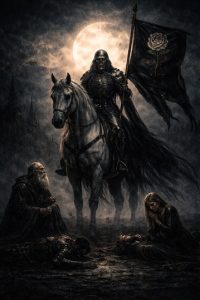
The Death Tarot Card Meaning takes physical form in the iconic image of the armored rider, a figure that moves through all stations of human life without distinction.
Most traditional versions of this card, and the Rider-Waite-Smith deck established the template most readers know, depict a skeletal figure in black armor on a white horse, carrying a black banner bearing a white rose. The horse is often white. At its feet lie figures from different walks of life, a king, a priest, a child, a young woman, suggesting that the force this card represents moves without preference across all stations of human life. In the background, the sun sits low between two towers on the horizon, an image that deliberately resists being read as either sunrise or sunset, because the card is not about endings or beginnings alone but about the threshold between them.
The white rose is worth particular attention. In tarot symbolism, white roses carry associations with purity, but here the rose also appears on the Magician‘s garden and the Fool‘s tunic, connecting Death to the broader arc of the Major Arcana rather than isolating it as something apart from the journey. The sun at the horizon sits at that ambiguous point between night and day, reinforcing the card’s central theme: something is completing, and something else, not yet visible, waits on the other side. The black banner contrasts with these lighter elements, marking the weight of what is being left behind. Together these visual details build a picture that is solemn without being grim, purposeful rather than accidental.
The armor worn by the skeletal figure is another detail that rewards attention. It is the same kind of armor worn by the Knight cards in the Minor Arcana, grounding Death not in the supernatural but in the worldly. This is not a demon or a god. It is a force that operates within the same human landscape everyone else inhabits, which makes it more immediate, not less. This reinforces what serious students of Major Arcana symbolism return to repeatedly: the Death card represents a process, not a punishment.
The earliest surviving tarot decks, produced in northern Italy in the fifteenth century, did not include a title on the Death card. It was one of the few Major Arcana cards left deliberately unnamed in those original manuscripts.
Upright Interpretation
When this card appears upright in a reading, the Death upright meaning centers on necessary endings. Something is concluding, and the conclusion is real. There is no going back to what existed before. This can feel disorienting in the moment, but the card’s framing is not pessimistic. The imagery consistently points forward, toward what the clearing of old ground makes possible.
The Death Tarot Card Meaning in its upright position often surfaces during periods when a person is holding on past the natural end of something. A career that has plateaued past the point of growth, a relationship that has changed into something unrecognizable, a personal identity built around circumstances that no longer exist. The card names what the person may already sense but has not yet fully acknowledged. In that respect, the upright Death card functions almost as a permission slip, confirmation that it is appropriate to let go.
Upright, this card carries an element of conscious finality that distinguishes it from cards like the Tower, which represents sudden rupture, or the Wheel of Fortune, which describes cycles that will turn again. Death describes something that has genuinely completed its form. Where those cards suggest disruption or shifting cycles, the Death card indicates a genuine close. The chapter ends here. What comes next is genuinely new, not a continuation of what was.
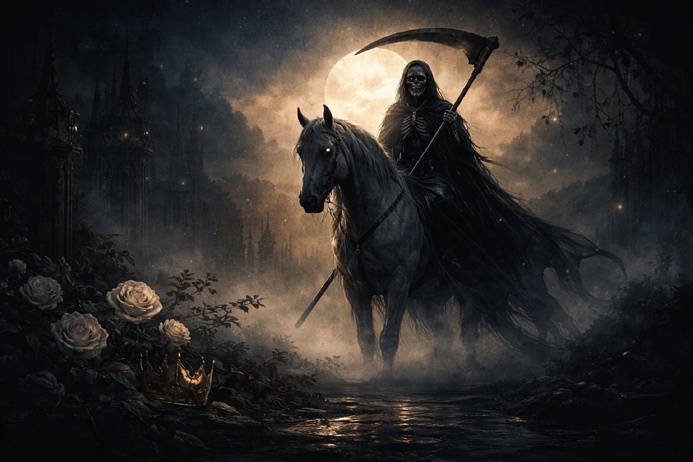
Death Tarot Card Meaning represented through transformation symbolism within the Major Arcana
Reversed Interpretation
The Death reversed meaning shifts the focus from the ending itself to the resistance surrounding it. When reversed, this card typically points to someone or something stuck at the threshold, aware that change is necessary but unwilling or unable to move through it. That stagnation carries its own weight. Energy that cannot transition tends to build pressure.
The Death Tarot Card Meaning in reversed position can also indicate that a transformation is in process but moving slowly, perhaps because it is internal rather than visible, or because external circumstances have slowed what would otherwise be a natural progression. It does not suggest that the ending has been avoided. More accurately, it suggests that the process is delayed or complicated.
Some readers interpret the reversed card as pointing toward a fear of endings that has become its own obstacle, and that fear is not weakness. The reversed Death card can reflect a genuine grief about what is being lost, which deserves acknowledgment before any movement forward is possible. The refusal to release what is finished keeps a person anchored to a past that no longer functions. In this reading, the reversed card is a signal to examine what is being held and why, not as a judgment but as useful information.
In the Tarot de Marseille tradition, which dominated European tarot for several centuries before the Rider-Waite-Smith deck, the skeletal figure was depicted on foot rather than on horseback, swinging a scythe across a field of severed heads and limbs of both common people and crowned figures.
The Card Within the Major Arcana
Positioning matters in tarot card archetypes. Death follows the Hanged Man, a card associated with suspension, waiting, and a shift in perspective achieved through stillness. After Death comes Temperance, sometimes called the card of the angel, which speaks to a slow and patient integration of what the transformation has left behind. That sequence is not accidental. Temperance’s kind of balance does not arrive without first passing through genuine loss. Seen in that sequence, Death occupies a precise and logical place in the spiritual journey in tarot: it is the moment of actual change between the pause that precedes it and the integration that follows.
This sequential logic is part of what makes the Major Arcana a coherent symbolic structure rather than a collection of isolated images. Each card responds to the one before it and sets up the one after. Death cannot be removed from that sequence without breaking the arc. Its presence is necessary precisely because real transformation requires a genuine ending, not just a modification.
The Death Tarot Card Meaning within this larger arc suggests that the card is not exceptional or alarming within the Major Arcana but is structurally essential. The journey through the major arcana moves through many difficult stations, including the Tower, the Devil, and the Moon, each naming a different kind of challenge or test. Death names the test of release.
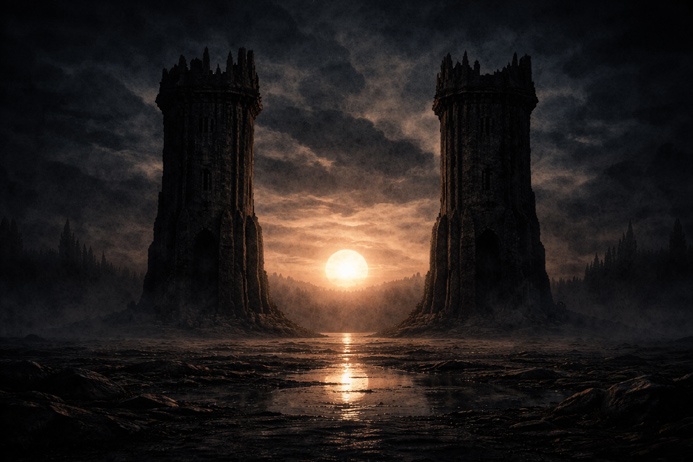
The two towers and suspended sun from the Death Tarot Card Meaning reflect the card’s structural position as a genuine crossing point within the Major Arcana sequence.
Common Contexts in Readings
The Death Tarot Card Meaning surfaces across a wide range of reading contexts. In questions about relationships, it often marks the genuine end of a connection or the end of a particular dynamic within an ongoing relationship. In career readings, it can indicate that a role, a field, or a professional identity has been outgrown. In readings focused on personal development, it tends to appear when an old self-concept is dissolving to make way for something more current.
Readers who encounter this card regularly note that clients sometimes feel relieved when it appears, particularly when they have been sensing an ending for some time but lacked clarity about it. The card provides that clarity. It does not create the ending. It names what is already occurring, and that distinction matters enormously when sitting with someone who is frightened by what they have drawn. The card witnesses; it does not judge.
What the card consistently does not indicate is failure. The Death Tarot Card Meaning, read carefully, is neutral in moral terms. Things end. Phases complete. The cycle turns. That is the function this card describes, without editorial comment on whether the ending is deserved or welcome.
Arthur Edward Waite, who commissioned the Rider-Waite-Smith deck published in 1909, wrote in his accompanying text that he considered the Death card to be among those whose true meaning was intentionally concealed from general audiences, suggesting its symbolism operated on a level he did not wish to explain publicly.
Approaching the Card in Practice
Major Arcana symbolism rewards a calm and unhurried approach when this card appears. Working with it in a reading calls for steadiness. Its imagery is deliberately striking, designed to hold attention and signal significance. The visual weight of the card is appropriate to what it represents: something meaningful is changing. That deserves acknowledgment.
At the same time, the Death Tarot Card Meaning does not call for dramatic response. The most useful posture when this card appears is one of honest assessment. What is ending? What has already ended that has not yet been acknowledged? What would become possible if the ending were accepted rather than resisted?
The spiritual journey in tarot moves through cycles of experience, and this card marks one of the most significant turning points in that journey. Its appearance in a reading is an invitation to take the transition seriously, to give it the attention it warrants, and to recognize that what follows a real ending is genuinely open.
Editor’s Reflection
What lingers after sitting with this card is how little it actually asks of a person, beyond honesty. The Death Tarot Card Meaning does not demand grief or celebration. It simply marks a line, and notes that the line has been crossed. Most people who have worked with tarot for any length of time come to see this card less as a warning and more as a kind of quiet confirmation, the deck acknowledging what life has already set in motion.
For those who have encountered this card in a reading, the experience tends to be specific to whatever was ending at the time. The Death Tarot Card Meaning can land very differently depending on what a person is carrying when it appears. What felt true about it then? What did it name that was difficult to say plainly? And looking back, was the thing that ended actually gone, or did it find another shape further down the road?

Known as The Man Who Notices, Mike Lamp is a theatrical hypnotist and psychic performer with more than twenty years of live stage experience. His work emphasizes observation, psychological influence, and measured presentation rather than spectacle or provocation. Performances are tailored for adult audiences, private events, and professional settings where control, clarity, and atmosphere matter.


Leave a Reply
You must be logged in to post a comment.