12
Feb
Secret Aleister Crowley Metaphysical Teachings Exposed
Aleister Crowley Metaphysical Teachings Revealed

Visual representation of Aleister Crowley metaphysical teachings through ceremonial objects and esoteric symbolism
The figure of Aleister Crowley remains one of the most polarizing personalities in Western esoteric history. Born in 1875 to a wealthy English family, Crowley spent his adult life developing, practicing, and documenting a comprehensive system of occult philosophy that would influence metaphysical movements throughout the twentieth century. Understanding Aleister Crowley metaphysical teachings requires moving past sensationalism to examine the actual structure and content of his work.
Crowley’s metaphysical framework drew heavily from established traditions while introducing innovations that set his approach apart. His teachings synthesized elements of Hermetic principles, Kabbalah, Eastern philosophy, and Western ceremonial magic into a coherent system he believed offered practitioners a path toward spiritual transformation. The complexity of this system and Crowley’s deliberately provocative presentation have both obscured and preserved his influence in contemporary esoteric circles.
The Foundation of Thelema Philosophy
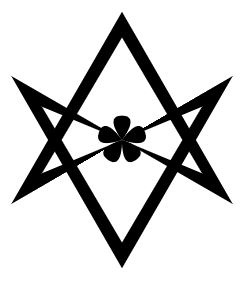
Aleister Crowley Metaphysical Teachings unicursal hexagram symbol is central to Thelema
At the center of Aleister Crowley metaphysical teachings stands Thelema, the philosophical and spiritual system Crowley claimed to have received through communications in Cairo in April 1904. The central text of Thelema, The Book of the Law, presents what Crowley described as a new framework for understanding human purpose and cosmic order.
Thelema philosophy rests on the principle “Do what thou wilt shall be the whole of the Law,” a statement Crowley insisted was not license for hedonism but rather an instruction to discover and fulfill one’s true purpose in the universe, what he termed the “True Will.” This concept formed the cornerstone of his metaphysical system. According to Thelema doctrine, each individual possesses a unique cosmic function, and the primary spiritual task involves identifying and manifesting this Will without interference from social conditioning or false desires.
The complementary principle, “Love is the law, love under will,” introduces a relational dimension to Thelema system. Crowley taught that authentic spiritual action aligned with True Will naturally produces harmony rather than conflict, since each being operating according to their genuine nature occupies a necessary position in cosmic order. This framework attempted to reconcile individual sovereignty with universal law.
Crowley published over 100 books and pamphlets during his lifetime, many under pseudonyms including Master Therion, Frater Perdurabo, and To Mega Therion.
The Ceremonial Magick System
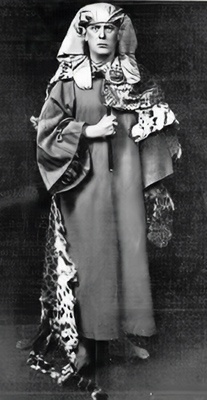
Aleister Crowley metaphysical teachings in Golden Dawn garb, 1910
Aleister Crowley metaphysical teachings included an elaborate ceremonial magick system that built upon the traditions of the Hermetic Order of the Golden Dawn, an organization Crowley joined in November 1898 His magical practice combined ritual structure, symbolic language, and psychological technique in ways that anticipated later developments in both occultism and psychology.
Crowley defined magick (spelled with a ‘k’ to distinguish the occult science from stage illusion) as “the Science and Art of causing Change to occur in conformity with Will.” This definition reframed magical practice as a technology of consciousness and manifestation rather than supernatural intervention. His ceremonial magick system employed specific tools, gestures, invocations, and visualizations designed to focus intention and alter states of awareness.
The rituals Crowley developed often involved elaborate preparation, including fasting, meditation, and the construction of ritual space according to precise specifications. Magical correspondences played a central role in ceremonial practice. Crowley organized colors, numbers, Hebrew letters, planetary influences, and divine names into complex tables of association that practitioners could employ to structure ritual work. These correspondences, documented extensively in his published writings, provided a symbolic language through which abstract metaphysical concepts could be enacted and experienced.
The A∴A∴ (Argenteum Astrum or Silver Star), Crowley’s magical order founded in 1907, used a graded system of initiation based on the Tree of Life with eleven degrees from Probationer to Ipsissimus.
Occult Metaphysics and Spiritual Structure
The occult metaphysics underlying Aleister Crowley metaphysical teachings presented reality as a layered system of interpenetrating planes or levels of existence. Crowley adopted and modified the Kabbalistic Tree of Life as a central diagram for understanding cosmic structure and human consciousness. This glyph mapped ten spheres or sephiroth, connected by twenty-two paths, representing stages of emanation from pure unity to material manifestation.
In Crowley’s occult metaphysics, spiritual development involved ascending this tree through direct experience rather than intellectual study alone. Each sphere represented specific qualities, challenges, and states of consciousness that the practitioner would encounter and integrate. The paths connecting these spheres corresponded to the letters of the Hebrew alphabet, tarot cards, and astrological symbols, creating a unified system of mystical symbolism.
Crowley emphasized that these diagrams and symbols were maps, not territories. The actual work involved personal exploration through meditation, ritual, and what he termed “astral projection practices” or work in visionary states. He documented detailed instructions for developing the capacity to operate consciously in non-physical dimensions of experience, describing techniques for maintaining awareness during sleep, entering trance states, and exploring symbolic landscapes.
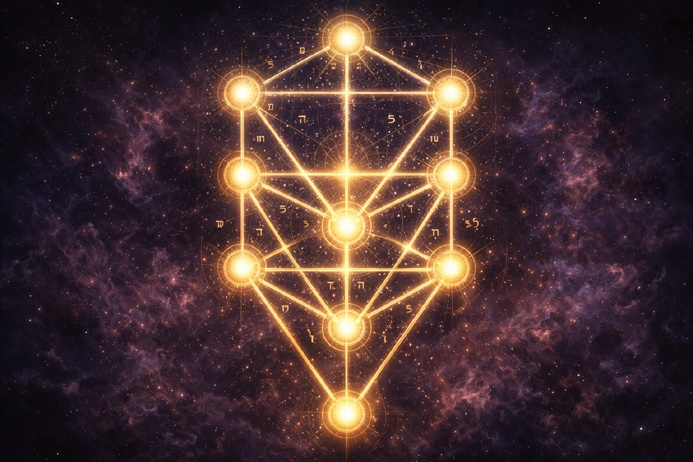
Aleister Crowley metaphysical teachings the Kabbalistic Tree of Life Diagram
Practical Techniques and Spiritual Alchemy
Aleister Crowley metaphysical teachings included practical methods intended to produce tangible results in consciousness. His approach to spiritual alchemy adapted traditional alchemical symbolism to describe processes of psychological and spiritual transformation. Rather than focusing on literal transmutation of metals, Crowley interpreted alchemical texts as coded instructions for inner work.
Meditation formed a central practice in Crowley’s system. He provided detailed instructions for developing concentration, recommending progressive exercises beginning with simple object focus and advancing toward sustained awareness without content. His text Eight Lectures on Yoga (later published as Yoga for Yellowbellies and other titles, also known from the collection Book 4 Part I) outlined these methods alongside breathing techniques (pranayama) and postures (asana) adapted from Eastern traditions.
Crowley also emphasized the importance of keeping detailed records. Practitioners were instructed to maintain magical diaries documenting rituals, meditation sessions, dreams, and daily observations. This practice served multiple functions: it developed observational precision, revealed patterns over time, and created a personal record of spiritual development. The discipline of documentation itself represented a form of magical training.
Read Major Arcana Secrets: Shocking Dark Origins Revealed Exclusive Article
The Hermetic Tradition and Western Roots
Understanding Aleister Crowley metaphysical teachings requires recognizing their placement within the broader Hermetic tradition. This stream of Western esoteric thought traces itself to texts attributed to Hermes Trismegistus, blending Greek philosophy, Egyptian religion, and mystical Christianity. Crowley positioned himself as both inheritor and reformer of this tradition.
The Hermetic principles of correspondence (“As above, so below”), vibration, polarity, and rhythm informed Crowley’s cosmology. He taught that these principles operated at all levels of existence, from cosmic to personal. Magical work, in this framework, involved consciously engaging these principles to create specific effects.
Crowley broke from some Hermetic precedents by rejecting moral dualism. Unlike traditions that framed spiritual work as a battle between good and evil, Thelema philosophy treated all energies as potentially useful depending on context and application. This approach drew criticism but reflected Crowley’s commitment to a non-dualistic framework where spiritual development meant integration rather than suppression.
Mystical Symbolism and Interpretive Systems
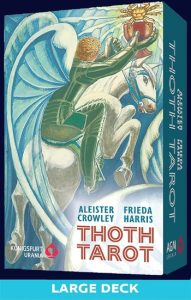
Crowley Thoth Tarot Deck (Large Edition) Click Image to buy from Amazon
The mystical symbolism pervading Aleister Crowley metaphysical teachings operated on multiple levels simultaneously. Crowley developed or adapted symbolic systems including tarot, astrology, and gematria (Hebrew numerology) as practical tools for accessing and organizing non-ordinary states of consciousness.
His tarot deck, designed with artist Frieda Harris and published as the Thoth Tarot, incorporated astrological, Kabbalistic, and alchemical symbolism into a visual system intended for both divination and meditation. Each card represented not just a fortune-telling image but a complex symbol encoding multiple layers of metaphysical teaching. Crowley’s book The Book of Thoth provided extensive commentary on these symbols and their relationships.
Crowley approached these symbolic systems as technologies of meaning. He taught that sustained meditation on properly constructed symbols could trigger specific states of consciousness and facilitate contact with dimensions of reality not accessible through ordinary awareness. The symbols functioned as interfaces between conscious and unconscious processes, between individual and universal patterns.
Crowley’s library at his death contained over 2,000 volumes on subjects ranging from mountaineering and chess to Sanskrit texts and medieval grimoires, reflecting the breadth of his intellectual interests beyond occultism.
Legacy and Contemporary Influence
Aleister Crowley metaphysical teachings continue to influence contemporary occult practice, ceremonial magic communities, and certain streams of modern spirituality. His emphasis on personal experimentation, detailed documentation, and psychological sophistication anticipated later developments in both esoteric practice and consciousness studies.
Organizations such as the Ordo Templi Orientis continue to teach and practice Thelema system as Crowley formulated it. Other practitioners have adapted elements of his system while discarding aspects they find problematic or outdated. His influence extends beyond explicitly Thelemic circles into modern chaos magic, neopaganism, and certain approaches to Western ceremonial magic.
Crowley’s work remains controversial. His deliberate provocation, his troubled personal life, and the genuine dangers associated with intensive occult practice without guidance create legitimate concerns. Responsible engagement with Aleister Crowley metaphysical teachings requires discernment, historical context, and recognition that Crowley documented his own experiences and interpretations rather than universal truths.
The metaphysical system Crowley developed represents a significant chapter in Western esoteric history. Whether approached as spiritual practice, historical study, or psychological framework, his teachings offer a detailed map of one individual’s attempt to codify and transmit methods for exploring consciousness and pursuing what he understood as spiritual transformation. The value and meaning of that system remain matters for individual assessment and, for those who choose active engagement, direct experience.
Read Essential Tarot Reading Explained Clearly Exclusive Article
Editor’s Reflection
Crowley’s work occupies an unusual position in Western spiritual history. His writings remain in print, his symbols appear in contemporary practice, and his ideas continue to provoke strong reactions decades after his death. The durability of Aleister Crowley metaphysical teachings suggests they address something persistent in human curiosity about consciousness, will, and transformation, even as the man himself remains deeply controversial. Whether that durability reflects genuine insight, effective self-promotion, or simply the appeal of transgressive imagery remains a matter of interpretation.
What draws people to esoteric systems that demand so much effort and offer so little conventional validation? Does the elaborate symbolic structure found in Aleister Crowley metaphysical teachings serve as genuine technology for exploring consciousness, or does it function primarily as psychological theater? And perhaps most importantly, what responsibility do we bear when we engage with teachings developed by someone whose personal conduct often contradicted his stated principles? These questions don’t have settled answers, but they’re worth considering before dismissing or embracing any metaphysical system wholesale.

Known as The Man Who Notices, Mike Lamp is a theatrical hypnotist and psychic performer with more than twenty years of live stage experience. His work emphasizes observation, psychological influence, and measured presentation rather than spectacle or provocation. Performances are tailored for adult audiences, private events, and professional settings where control, clarity, and atmosphere matter.


Leave a Reply
You must be logged in to post a comment.