31
Jan
Daniel Dunglas Home: Remarkable Historical Evidence
Daniel Dunglas Home: The Most Studied Physical Medium in History

Daniel Dunglas Home photographed in Scottish kilt, reflecting his birth heritage and social standing in Victorian society.
In the crowded field of 19th century Spiritualism, few figures commanded the attention that Daniel Dunglas Home received during his three-decade career. Born in Scotland in 1833 and raised partly in the United States, Home became known throughout Europe and America not for promoting a particular doctrine or building a religious following, but for the physical phenomena reportedly produced in his presence. Unlike many of his contemporaries, Daniel Dunglas Home never charged fees for his séances, never performed on a public stage, and never was publicly exposed as a fraud despite repeated investigations by scientists and skeptics.
What set Home apart was not merely the dramatic nature of the events described by witnesses, but the willingness of educated observers to put their reputations at risk by documenting what they claimed to have seen. Home’s séance manifestations included levitations of furniture and his own body, the appearance of luminous phenomena, the elongation of his physical frame, and the handling of hot coals without apparent injury. These accounts came not only from believers but from individuals whose professional standing depended on credibility and careful observation.
Read Fox Sisters Psychic Commercialization Revealed Exclusive Article
Early Life and the Beginning of Phenomena
Daniel Dunglas Home experienced his first reported psychic events as a teenager living in Connecticut. In his teenage years, he described seeing an apparition of a deceased friend, an experience that coincided with rapping sounds heard throughout the household. His adoptive family, already uneasy with the events, asked him to leave after furniture reportedly began moving in his presence. This early pattern of physical mediumship phenomena would define the rest of his life.
Home did not seek out his abilities or attempt to cultivate them through training. He described them as involuntary and occasionally distressing. By his early twenties, word of the phenomena occurring around him had spread through Spiritualist circles in New England. Reports described tables lifting completely off the ground, musical instruments playing without visible contact, and cool breezes moving through sealed rooms. Home accepted invitations to demonstrate these occurrences in private homes, establishing the pattern he would follow throughout his career: small gatherings, no admission fees, and often some degree of light in the room.
Daniel Dunglas Home conducted séances for Emperor Napoleon III and Empress Eugénie at the Tuileries Palace in Paris on multiple occasions between 1857 and 1858, with phenomena reportedly including table movements and spirit communications witnessed by members of the French court.
European Reception and Social Standing
In 1855, Daniel Dunglas Home traveled to England, where he would spend much of his remaining life. Victorian society was particularly receptive to Spiritualist ideas, and Home found himself welcomed into aristocratic homes across Britain and the Continent. He conducted séances for Napoleon III in France, for the nobility in Russia, and for countless members of the British upper classes. His social standing was unusual for a medium. He married into minor Russian nobility, moved comfortably in elite circles, and maintained friendships with writers, scientists, and cultural figures.
This social acceptance came with scrutiny. Home’s critics suggested that his upper-class connections protected him from the kind of exposure that ruined other mediums. His supporters countered that these same educated witnesses were precisely the people most capable of detecting trickery. The debate over Home’s legitimacy continued throughout his life and has persisted among researchers ever since.
Physical Phenomena and Levitation Demonstrations
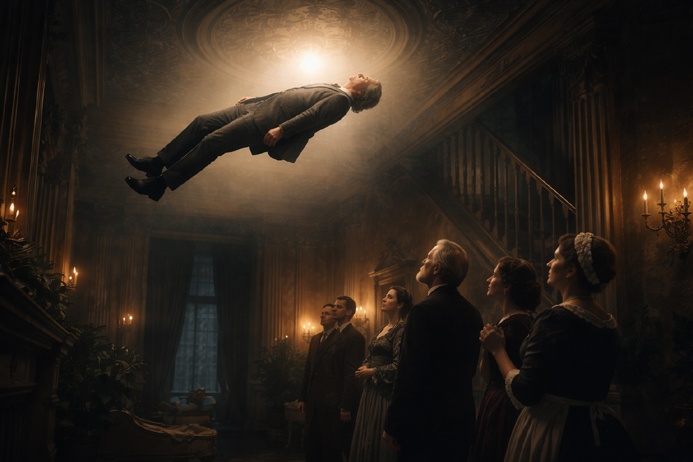
Daniel Dunglas Home doing a nineteenth-century levitation séance depicted inside a Victorian home, capturing the tension between belief, spectacle, and the unseen forces of the era.
The centerpiece of Daniel Dunglas Home’s reputation rested on reports of levitation. Witnesses described him floating horizontally in mid-air, rising to the ceiling, and in one famous incident, floating out of one window and into another while several floors above the street. These levitation demonstrations occurred in various settings and were described by multiple witnesses who had no apparent reason to fabricate their accounts.
The December 13, 1868 levitation at Ashley House in London remains the most discussed incident. Three witnesses, including Lord Adare and the Master of Lindsay, reported that Home entered a trance state, then floated out of a third-floor window in one room and re-entered through a window in an adjacent room. The windows were approximately seven feet apart with a gap of several stories to the street below. All three witnesses provided written statements describing the event. Skeptics have suggested misperception, collusion, or simple dishonesty, but no definitive explanation has been universally accepted.
Other physical mediumship phenomena attributed to Home included accordion music produced while the instrument was held by one end in a wire cage, visible luminous hands and forms, sudden changes in his height during trance states, and the handling of red-hot coals removed from the fireplace. These events were not occasional occurrences but regular features of his séances, witnessed by hundreds of people over many years.
Read Houdini Debunking Psychics: The Ruthless Truth Exclusive Article
William Crookes Medium Research and Scientific Investigation
The scientific investigation of mediums in the Victorian era reached its most rigorous expression in the research conducted by chemist and physicist William Crookes. Between 1871 and 1874, Crookes investigated Daniel Dunglas Home under controlled conditions in his own laboratory. Crookes was already a Fellow of the Royal Society and had made significant contributions to chemistry and physics. His decision to study Home was motivated by scientific curiosity rather than belief.
William Crookes medium research employed instruments designed to detect fraud or measure physical forces. He constructed a special apparatus to test whether psychic force could register on a spring balance when Home held his hands over a mahogany board. Crookes reported positive results, with the apparatus showing variations in weight that could not be explained by normal physical contact. He also witnessed accordion music produced while the instrument was inside a wire cage under the table, with Home touching only one end through the wires.
Crookes published his findings in the Quarterly Journal of Science, describing the phenomena as genuine and worthy of serious investigation. The scientific community did not respond favorably. Many colleagues accused Crookes of being deceived or of abandoning scientific rigor. Others suggested that his instruments were inadequate or that he had failed to control for trickery. Crookes defended his work but ultimately moved on to other research. His reputation suffered, but he maintained until his death that the phenomena he witnessed with Home were real.
The Russian novelist Leo Tolstoy attended a séance with Daniel Dunglas Home in the 1860s Russia and later wrote dismissively about Spiritualism, though he acknowledged the widespread fascination with Home among Russian aristocracy during that period.
Victorian Era Séances and Cultural Context
To understand Daniel Dunglas Home’s career requires understanding the cultural landscape of Victorian era séances. The Spiritualist movement had begun in America in 1848 with the Fox sisters and their reported communication with spirits through rapping sounds. Within a decade, Spiritualism had spread to Britain and Europe, attracting millions of followers and provoking intense debate about the nature of consciousness, survival after death, and the limits of scientific knowledge.
Victorian era séances ranged from private family gatherings to elaborate public demonstrations. Many mediums performed in darkness or required restraints that could be manipulated. Home stood apart by often working in sufficient light for observers to see clearly, by avoiding cabinets or screens that could conceal assistants, and by submitting to conditions set by investigators. These factors did not prove authenticity, but they made conventional fraud more difficult to execute undetected.
The séance culture of the period also produced numerous exposures of fraudulent mediums. Professional magicians attended séances and revealed methods for producing spirit phenomena through sleight of hand, hidden assistants, and mechanical devices. The most famous mediums of the era, including the Davenport Brothers and Florence Cook, faced accusations and controversy. Daniel Dunglas Home, despite his prominence and decades of activity, never faced a definitive exposure.
Home’s Later Years and Legacy

Daniel Dunglas Home is often cited as the rare case who got away from Houdini debunking psychics efforts
Daniel Dunglas Home’s health declined in his later years, possibly due to tuberculosis. He continued to hold séances when his condition allowed, but with less frequency. He wrote two autobiographical works defending his experiences and responding to critics. He died on June 21, 1886 at age 53, maintaining until the end that the phenomena occurring in his presence were genuine manifestations of forces beyond current scientific understanding.
Home’s legacy remains contested. Skeptics view him as a skilled illusionist who benefited from credulous witnesses and inadequate investigation methods. They point to the absence of phenomena under truly controlled laboratory conditions and the inherent unreliability of eyewitness testimony, particularly in low-light situations with participants predisposed to belief. The fact that Home’s phenomena have never been reliably reproduced under scientific conditions suggests, to critics, that they never occurred as described.
Supporters counter that Daniel Dunglas Home represents the most studied physical medium in history precisely because standard explanations fail to account for all the documented reports. The number of witnesses, their diversity, their social standing, and the consistency of accounts across decades and continents create a historical puzzle that dismissal does not resolve. Whether Home produced genuine phenomena or represents an unsolved case of sustained deception remains an open question in the study of 19th century Spiritualism.
Daniel Dunglas Home published two autobiographical works during his lifetime: “Incidents in My Life” in 1863 and “Incidents in My Life, Second Series” in 1872, both providing his personal account of séance phenomena and responding to critics who questioned his authenticity.
Assessing the Historical Record
Modern researchers examining Daniel Dunglas Home face significant challenges. No photographic or film evidence exists, only written testimony from participants and observers. Psychological research has demonstrated the unreliability of eyewitness accounts, particularly under conditions of suggestion, expectation, and group dynamics. The Victorian era lacked the sophisticated fraud-detection methods available today, and even trained observers could be fooled by techniques that would seem obvious to a modern magician.
Yet the historical record surrounding Home differs from that of other mediums in important ways. The consistency of reports across different locations, the willingness of skeptical observers to document phenomena, and the absence of exposure despite intense scrutiny create a pattern that does not fit easily into standard categories of either fraud or misperception. Whether this pattern reflects genuine anomalous phenomena or merely the limitations of historical investigation remains unresolved.
Daniel Dunglas Home’s career represents a specific moment in Western cultural history when educated society took seriously the possibility that consciousness might survive death and that spiritual forces might interact with the physical world. The investigation of such claims through scientific methods, however imperfect, marked an important development in how unusual experiences were approached. Home himself remains an enigmatic figure, neither clearly vindicated nor definitively exposed, but documented more thoroughly than perhaps any other medium of his era.
Editor’s Reflection
The question of what actually occurred in the presence of Daniel Dunglas Home will likely never be settled with certainty. The historical record offers extensive documentation but no definitive proof, leaving researchers and interested readers to weigh testimony against skepticism, witness credibility against the possibility of shared delusion or skilled deception. What remains undisputed is that Home occupied a unique position in Victorian Spiritualism investigated more thoroughly than his peers, socially positioned in ways that defied the typical medium’s trajectory, and never conclusively exposed despite decades of scrutiny.
Whether the phenomena surrounding Daniel Dunglas Home represented genuine anomalies or an elaborate performance we can no longer reconstruct, his case raises questions that extend beyond historical curiosity. What would constitute adequate proof of such claims, and would we recognize it if presented today? How do we assess testimony from educated, skeptical observers when their accounts describe events that contradict our understanding of physical law? And perhaps most interestingly, why does this particular figure continue to resist easy categorization more than a century after his death, when so many of his contemporaries have been relegated to footnotes in the history of fraud and credulity?

Known as The Man Who Notices, Mike Lamp is a theatrical hypnotist and psychic performer with more than twenty years of live stage experience. His work emphasizes observation, psychological influence, and measured presentation rather than spectacle or provocation. Performances are tailored for adult audiences, private events, and professional settings where control, clarity, and atmosphere matter.


Leave a Reply
You must be logged in to post a comment.